How I Photographed a Total Lunar Eclipse
I don’t go on trips specifically for night sky photography nearly as often as I used to. Maybe it’s because I’ve lately adopted a more spontaneous approach to landscape photography, which doesn’t rely so much on detailed planning and doesn’t come with high expectations.
That said, I have to admit that I still really enjoy the planning itself, and I do miss night photography from time to time. A rare event in the night sky, like the total lunar eclipse in September 2025, was exactly the kind of motivation I needed to head for such a photo trip again. So once more, I spent hours studying maps, weather models, and chasing perfect conditions with fairly high expectations.
To spice things up a bit, I also decided to document the whole process on video. I’d been thinking about making videos for quite a while. Watching other photographers on YouTube had slowly planted the idea that I might actually enjoy sharing the stories behind my photos this way. Still, photography has always been my top priority, so I kept putting those ideas aside. I didn’t want filming to complicate things. This time, though, I finally went for it.
What attracted me most about the total lunar eclipse was one thing in particular – the possibility of photographing a dark night sky with the core of the Milky Way during a full Moon. Under normal circumstances, that’s practically impossible. Even a partially illuminated Moon brightens the sky so much that most stars simply disappear.
That’s why the Moon largely dictates when astrophotographers head out into the field. During a total eclipse, however, the full Moon briefly passes into Earth’s shadow and its brightness drops significantly. It doesn’t disappear completely, though, because Earth’s atmosphere bends and scatters sunlight into the shadow. Since especially longer wavelengths pass (those in the red part of the spectrum), the Moon turns red, hence the term “blood moon.” I simply couldn’t miss that.
In Czechia, the totality began a few minutes before sunset and moonrise, and ended at around 9:30 PM. That left only a short window between usable darkness for shooting stars and the end of the eclipse. Source: StellariumWeb
Location
In the end, I chose my favorite mountain range, the Krkonoše. Forecasts suggested the highest chance of clear skies there. I picked a spot along the ridge with an open view to the east and with characteristic rounded granite rock formations, which worked perfectly as foreground elements for a wide-angle composition.
The eclipsed Moon was going to be in the east, while the core of the Milky Way would sit to the south. That left a relatively large empty space in between, which I could nicely fill with those granite boulders.
I was also tempted to shoot the Moon with a long focal length alongside some distant subject. But since I was up on the ridge with most of the landscape below me, I kind of lost that opportunity. So the wide-angle shot became the priority.
Gear
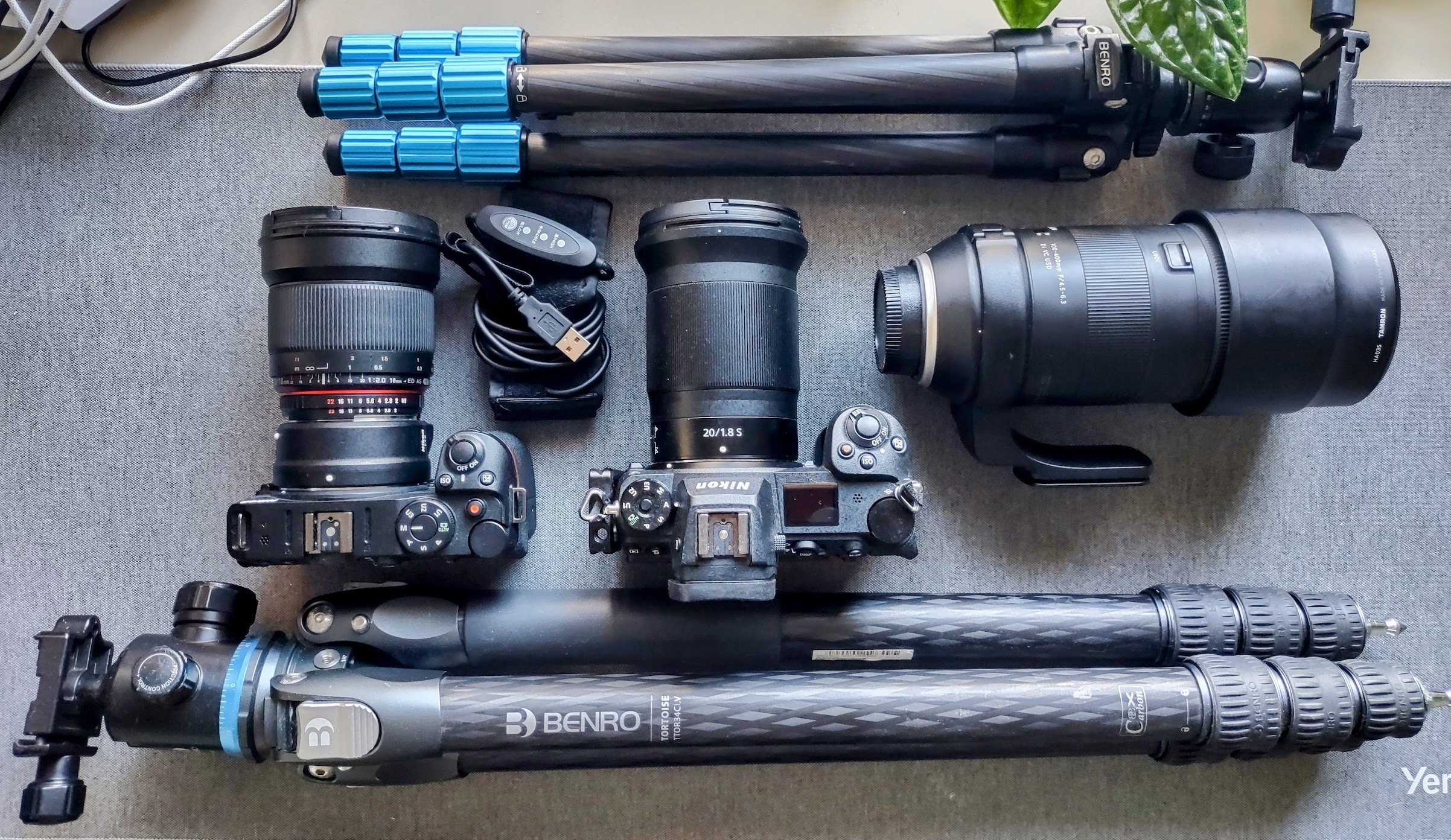
Since I was mainly focused on a wide-angle composition, I went with my fast Nikkor 20mm f/1.8 mounted on a Z7 II – my main camera. This lens is incredibly sharp and has very few if any optical aberations, which is especially useful when stitching multiple images into a panorama. That said, for a prime wide-angle, it’s quite large and heavy, but that’s really its only downside.
I also brought a second wide-angle lens, the Samyang 16mm f/2, mounted on my Z30 (a small APS-C camera), which I planned to use for timelapsing. For the Z30, I packed a Tamron 100–400mm as well. With the APS-C crop factor, that gives me up to around 600mm, which is ideal for capturing details of the Moon.
A sturdy tripod is, of course, essential, one for each camera obviously. I also packed a lens heater to prevent fogging, and a nodal rail in case I needed to shoot the foreground as a panorama. I even brought a star tracker, but ended up not using it. These days, I mostly don’t use the remote shutter anymore, and just use the camera’s built-in intervalometer.
Weather in the Krkonoše mountains can change quickly and unexpectedly, especially along the ridge. Warm clothing for night shooting is a must. A thermos with tea also comes in handy. With all that, it’s probably no surprise that my backpack ended up being ridiculously heavy.
How I Shot It
First of all, I made sure to arrive early, about an hour before things started. I wanted enough time to scout the location, fine-tune compositions, set up my gear, and eat my dinner.
At the beginning of the total phase, the Moon was still below the horizon and the Sun was just about to set. I already had my telephoto pointed east, waiting for the Moon to appear. I even tried to include Sněžka in the frame (the highest peak of Czechia), since it was relatively close to where the Moon would rise. In the end, though, it took more than half an hour before the eclipsed Moon was visible at all due to the remaining light in the sky.
While waiting for it to get properly dark, I focused on shooting the foreground. Capturing the foreground during twilight is a common technique, which allows for shorter exposures, saving time and reducing noise. Even so, I shoot each foreground frame three times, which helps reduce noise even further. In the end, I managed to capture two out of the three planned compositions. The first one fit into a single frame, while the second required a panorama using a nodal rail with two vertical frames at two focal planes. It was a bit of a race against time to finish everything before the total phase ended. I then shot the sky for both compositions together. I always aim for at least 5–10 exposures that I average in post. With 15-second exposures, that already takes a bit of time. Finally, I took a short exposure just for the Moon to preserve detail in its reddish surface (at 15 seconds, even the eclipsed Moon gets easily blown out).
I finished just in time. About a minute or two after I stopped shooting, the total phase ended. As soon as the Moon started to emerge from Earth’s shadow, stars began disappearing from the sky, and within minutes, I was the one casting a shadow on the ground. Crazy.
Everything happened so fast that I didn’t manage to properly film and comment on the process. In the end, I stopped worrying about the video and just enjoyed the partial phase myself. I put the camera down for a while and simply watched. Leaving the camera aside and just staring at the sky is actually an important part of night photography for me. It’s almost therapeutic. I encourage everyone to focus on this too in your nightsky workflow.
Final Thoughts
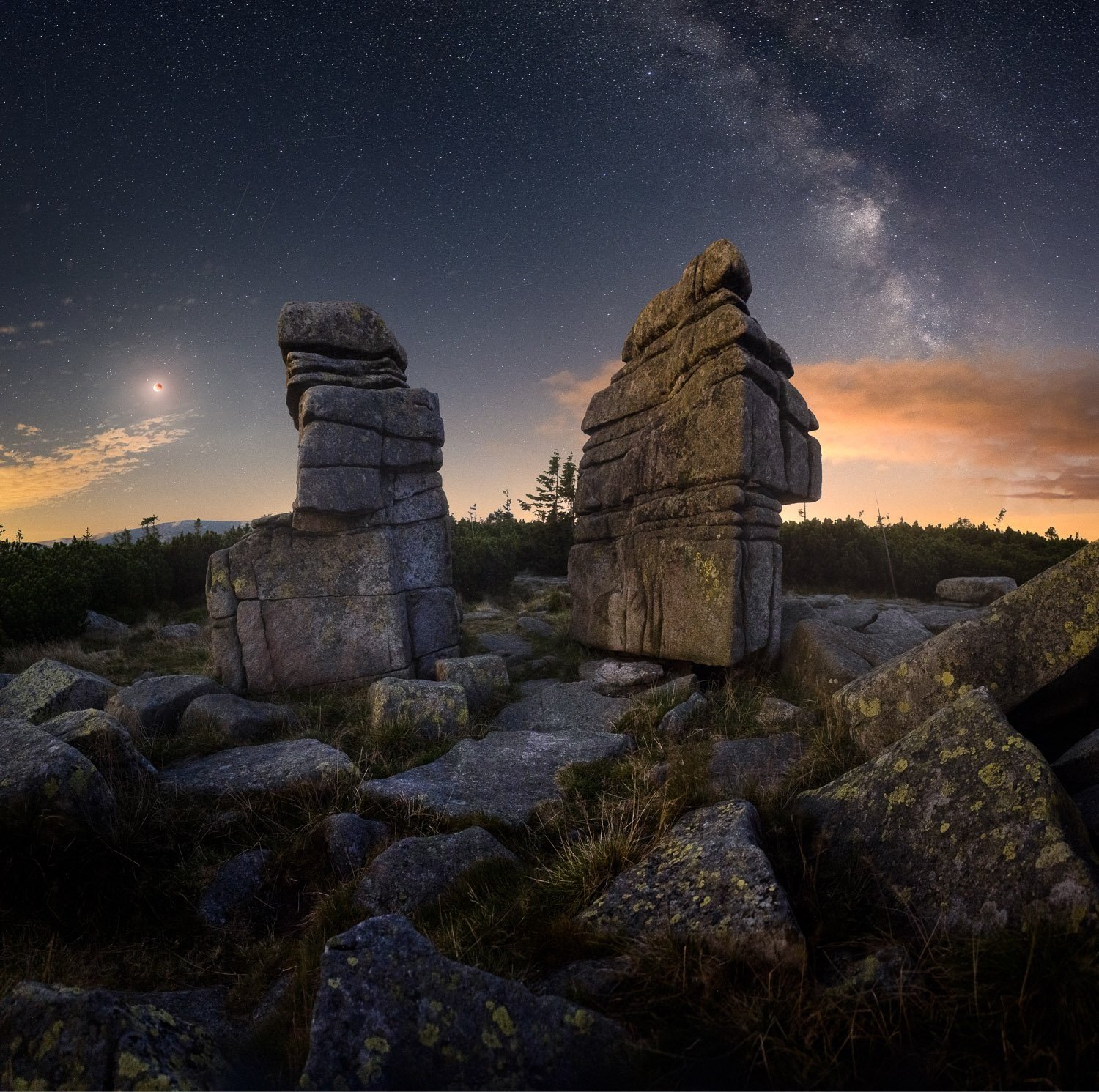
Above is one of the final images. I shot the foreground as a two-frame vertical panorama at two focal planes using a nodal rail, as I wanted to include the lichen-covered rocks in the very front to frame the scene. I’m really happy with the result, even though it’s not perfect. Because of the wide field of view, the Moon might be a bit too small in the frame. There were also some clouds reflecting light pollution from the foothills, which actually kind of help the composition and color balance, but I’d probably still prefer not to have them there. Well, you can’t have everything.
Overall, I enjoyed the whole experience a lot, and my expectations were pretty much met. On top of that, it was a great trip to the Krkonoše mountains. What more could I ask for?
And how did my first attempt at a video blog turn out? You be the judge. (video is in Czech with English subtitles)